Why Mardi Gras Is the Proving Ground
Every hotel in the city sells out. Streets close without apology. Restaurants stop answering the phone. A million people pour into a city built for 380,000, and the city, frankly, does not care about your itinerary.
Which is exactly why it's the most valuable week of the year for high-stakes hospitality. Anyone can impress a guest in a private dining room in October. Delivering privacy, exclusivity, and flawless pacing during beautiful chaos is a different sport. Your guests know it. That's the point. The difficulty is the luxury.
We've produced events in New Orleans for fourteen years. More than a hundred programs in this city, for clients ranging from a professional sports league to global manufacturers to private investor groups. One of those programs is the spine of this guide.
The Anchor
A $250K takeover at peak Mardi Gras.
The brief: 24 high-net-worth guests, four nights, peak Mardi Gras weekend. Wild, high-touch, and completely seamless. The kind of brief most planners politely decline, because every lever you'd normally pull, hotel inventory, restaurant availability, street access, is gone.
- A full hotel floor buyout at one of the city's top boutique hotels, all 24 guests together, plus a dedicated suite transformed into their daily happy hour lounge
- A welcome reception with custom cocktails, surprise entertainment, and a cocktail experience built around a New Orleans historian
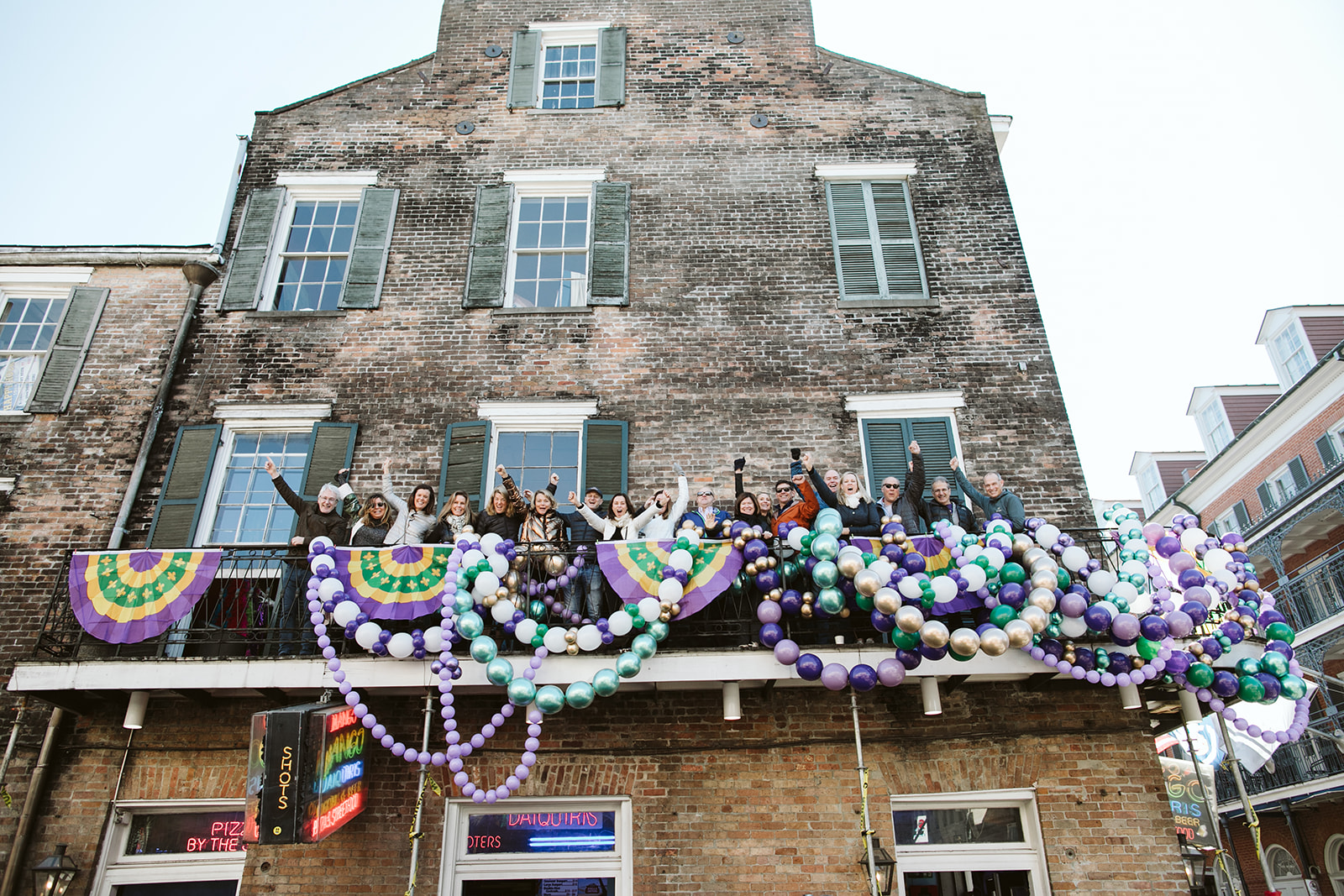
- A private Bourbon Street balcony lunch on Friday, timed to the exact window when locals take over the French Quarter
- A second line parade through the Quarter with a brass band, Mardi Gras Indians, and a juggler clearing the way
- VIP parade viewing and a private dinner that evening
- A ride on their own float in the Krewe of Tucks, every guest suited up and throwing beads to the crowd instead of standing in it
- On-demand IV drips back at the hotel, because recovery is part of the design, not an afterthought
The text that came the next morning: "You outdid yourself. This is the best money I've ever spent."
The perch above the chaos. Guests stay anonymous; the city doesn't.
The rest of this guide is the thinking behind that weekend, made reusable.
Part 1 · Venue Intelligence
Sanctuary, perch, or starring role.
The venue is the stage, not the play. But pick the wrong stage during Mardi Gras and there is no play. What matters in this week is a venue's relationship to the chaos: does it give you privacy from it, a balcony seat above it, or a starring role inside it? A multi-day program needs all three.
Every venue below is one we have actually produced in or personally vetted. That's the standard for everything in The Little Black Book. No aggregated reviews, no top-ten lists written from a desk.
One thing you'll notice: some venues are named and some are described. That's deliberate. During Mardi Gras, location decides everything: the hotel on the right block, the balcony over the right stretch of street. Those addresses are the most valuable intelligence in this guide, which is exactly why they aren't printed in it. The thinking is free. The addresses come with a contract.
The boutique hotel we won't name
Sanctuary · French Quarter adjacent
Full-floor buyouts are the single most valuable move at Mardi Gras: your guests get the city on their terms and a retreat from it on yours. A dedicated suite converted to a private lounge turns the hotel from accommodation into headquarters. What makes this property work is the thing we can't print: where it sits relative to the routes, the noise, and the walk home at 1 a.m.
The Orpheum Theater
Sanctuary · CBD · produced here twice
A restored historic theater with a grand main floor, ornate balconies, and a speakeasy-style basement that exists for exactly one purpose: the mid-evening reveal. We've produced a 300-guest international corporate evening and a 200-guest industry reception here, and both times the basement was the moment guests still talk about. A venue that contains its own second act.
The Civic Theatre
Sanctuary · CBD · brand launch proven
Where we launched a global manufacturer's rebrand to an international guest list: signature cocktail on entry, a curtain-drop reveal of an aerialist and jazz trio mid-program. The Civic rewards theatrical pacing. If your event has an announcement at its center, this is the room.
The balcony (you'll understand why no address)
Perch · French Quarter
The balcony is the most misunderstood asset in the Quarter. Tourists rent them at night, which is amateur hour. The professional move is a private balcony lunch on Friday, in the window when locals own the streets below. Same balcony, completely different city. Which balcony, over which block, at which hour: that's the job.
The street itself, via second line
Immersion · permitted & escorted
A brass-band parade with police escort is a venue, and it's the one only this city offers. We've used second lines to turn a 15-minute transfer into the headline of the post-event survey. Permitted, escorted, and designed, it is the safest possible way to put guests inside the chaos rather than behind glass.
A Krewe float, by invitation and arrangement
Immersion · relationship asset
The single highest-value experience in this guide. Riding, not watching. Suited up, beads in hand, crowd below. This is relationship capital and lead time, not a booking, and it is precisely the kind of access that separates a strategy partner from a vendor.
Restaurant Intelligence · From the Index
Five from our book, scored.
Every booking window below is the normal-week number. During Carnival, double it at minimum, and for anything in the Quarter, call early.
Galatoire's
French Quarter · $70–100 pp · PDRs seat 20–40
Old New Orleans, here since 1905 and proudly unchanged. Friday lunch downstairs is a New Orleans institution, which makes it the natural ancestor of our balcony-lunch move: the locals' window is a real thing, and Galatoire's is where it was invented. Upstairs private rooms for serious business.
Taste 8Soul 10Generosity 9Ease 7
Brennan's
French Quarter · $70–100 pp · courtyard PDRs seat 20–60
New Orleans royalty, better than ever after its renovation. Breakfast in the courtyard is the quiet-morning move during a loud week, and the tableside Bananas Foster is required, not optional.
Taste 8Soul 9Generosity 9Ease 9
Restaurant August
CBD · $90–130 pp · PDRs seat 12–30
Fine dining at its New Orleans apex, and where power players close deals. Deep wine list, elegant private rooms. If your program has one dinner where the business actually happens, it happens here.
Taste 10Soul 8Generosity 9Ease 8
Upperline
Uptown · $55–75 pp · small rooms seat 20–30
Uptown's beloved treasure, filled with art and personality. When the week's energy is all brass and beads, Upperline is the counterweight: quintessential New Orleans character at conversation volume.
Taste 8Soul 10Generosity 9Ease 8
Sazerac Bar at The Roosevelt
Moment · walk-ins only
The Art Deco room where the Sazerac was born. No reservations, which during Mardi Gras means this is a designed detour, not a plan. Worth designing the detour.
Taste 8Soul 10Generosity 8Ease 8
The full book runs 33 New Orleans entries and 316+ nationwide, every one scored and annotated from real production experience. Clients get the book.
Part 2 · The Experience Architecture
The venues are nouns.
This is the grammar.
Every high-stakes multi-day program we build follows the same five-phase arc, and the Mardi Gras takeover is the cleanest example we've ever produced.
Phase 1 · Arrival
The first 90 minutes set the contract.
Guests came off planes into a welcome reception with custom cocktails and surprise entertainment. Nobody asked where to check in. The message, never spoken: you are expected, specifically.
Phase 2 · Decompress
High performers need a backstage.
The private floor and the daily happy hour suite. Without a backstage, the energy you spent months designing leaks out through a hotel lobby shared with 400 strangers in feather boas.
Phase 3 · Cultural access
Being let in, not visiting.
The historian cocktail hour. The balcony lunch in the locals' window. Not experiences bolted on: the city explained from inside, at the right hour, by the right people.
Phase 4 · The peak moment
One moment gets the full budget of surprise.
The float ride. It must be the one thing nobody in the room could have bought for themselves. Everything before it builds; everything after it lands.
Phase 5 · Recovery
The last impression, as composed as the first.
IV drips at the hotel. Late checkout choreography. The quiet morning after the loud night. Programs that skip this phase end on their worst note and don't know why.
Sequence matters more than spend. The same seven components in the wrong order is just an expensive itinerary.
Part 3 · The Invisible Logistics
The glamour is rented.
The discipline is owned.
What the guests never saw that weekend: street closures mapped against every transfer. Police escort coordination. Compliance on every pour outside the hotel. Vendor loads timed around parade routes that change by the hour. A team member awake whenever guests were.
This is the part of the work nobody photographs, and it is most of the work. We've written elsewhere about an event that died two weeks out because one public promise was never checked against state law. At Mardi Gras the regulatory surface is ten times larger, and the city will not bend.
On gifts, because someone will ask: source the destination, not the catalog. If it ends up on a desk or a wall five years later, it was a gift. If it ends up in the hotel room trash, it was a logo.
When to start: krewe access, floor buyouts, and balcony inventory move 9 to 12 months out. If your program is for next spring, the right conversations happen now.